
Annual Aircraft Inspection Readiness: What MRO Shops Need on Hand
Oct 29th 2026

Annual inspection season does not announce itself. It just arrives. For MRO facilities, repair stations, and A&P shops running a steady book of aircraft, the calendar is relentless: annuals expire every 12 calendar months, 100-hour intervals stack on top, and that ELT battery that was borderline six months ago is now out of compliance.
The shops that come through the inspection season without delays are the ones that are prepared. Consumables ordered, hardware in stock, documentation organized before the first aircraft rolls into the bay. This guide covers what the regulations require, what each inspection phase checks, and what your team needs on hand to get through the job without mid-job interruptions.
What FAR 91.409 Requires: How the Calendar Actually Works
Under 14 CFR Section 91.409, most civil aircraft operating under Part 91 require an annual inspection every 12 calendar months. That 12-month window runs on calendar months, not individual days. An annual signed March 15 expires at the end of March the following year, not on March 15. That distinction gives shops a practical lever: schedule inspections early in a calendar month and the aircraft gains almost a full extra month of coverage at no additional labor cost.
Only an IA (Inspection Authorization holder), a Part 145 repair station rated for the aircraft type, or the aircraft manufacturer can approve an annual and return the aircraft to service. An A&P without an IA can assist with the physical inspection and perform maintenance but cannot sign off the annual.
For aircraft operated for hire, or used to provide flight instruction for hire, a 100-hour inspection is also required under FAR 91.409(b). An A&P without an IA can approve a 100-hour. The key distinction: an annual inspection satisfies any outstanding 100-hour requirement. A 100-hour does not substitute for an annual.
What the Annual Inspection Covers
FAR 43, Appendix D defines the scope of annual and 100-hour inspections. Every covered aircraft must be inspected across nine major groups: propeller, engine, cabin, fuselage and empennage, wings, landing gear, floats and ski equipment where applicable, operational systems including lights and flight controls, and general condition and documentation. That is the regulatory floor.
For older airframes, high-time engines, or aircraft with recurring airworthiness directives, the inspection goes deeper. Every applicable AD must be researched, confirmed as complied with, and documented before the IA signs. An inspector who approves an aircraft with open ADs is approving an unairworthy aircraft. Most experienced IAs begin AD research before the aircraft enters the shop.
Before returning any reciprocating-engine aircraft to service, FAR 43.15(c) requires a full engine run-up to verify satisfactory performance per the manufacturer's recommendations. This covers oil pressure, RPM, magneto drop, and carb heat or fuel injection operation. For turbine-powered aircraft, the same requirement applies under FAR 43.15(c)(3). Document the run-up results in the logbook entry.
The AV1ATED Compliance Calendar
Many technicians use the AV1ATED mnemonic to track every inspection interval an aircraft must maintain. When you are already pulling a customer's aircraft for its annual, it costs minutes to cross-reference the full list. Missing one means a return trip, a delay, and an avoidable conversation with the customer.
| Letter | Inspection | Regulation | Interval |
|---|---|---|---|
| A | Annual inspection | FAR 91.409(a) | 12 calendar months |
| V | VOR check (IFR operations) | FAR 91.171 | Every 30 days |
| 1 | 100-hour inspection (for-hire operations) | FAR 91.409(b) | 100 hours time in service |
| A | Altimeter / Pitot-Static system | FAR 91.411 | 24 calendar months |
| T | Transponder | FAR 91.413 | 24 calendar months |
| E | Emergency Locator Transmitter (ELT) | FAR 91.207 | 12 calendar months |
| D | Airworthiness Directives | FAR 39 | Per AD requirement |
The ELT is worth flagging at every intake. Under FAR 91.207, ELT batteries must be replaced or recharged when 50% of their useful life has expired, or following a cumulative one hour of use. If the battery placard shows expiry within six months of the inspection date, replace it during the annual. For more background on inspection requirements, the AOPA Guide to Aircraft Inspections is a practical reference to share with customers unfamiliar with the compliance schedule.
Always confirm compliance against the aircraft's AMM or SRM before return to service. The regulatory minimum is where the checklist starts, not where the inspection ends.
What to Have on Hand Before the Aircraft Comes In
This is the section most inspection guides skip. Those guides are written for aircraft owners. For repair stations and MRO teams, the supply question is operational. Running out of safety wire or the right crush gasket mid-teardown does not just waste time. It occupies hangar space and pushes every aircraft behind it in the queue.
Below is a consumables breakdown by inspection area for a typical reciprocating-engine GA aircraft. Scale quantities to your monthly inspection volume.
Engine compartment
Engine oil and the correct oil filter for the engine model are obvious starting points. Less obvious: AN900-series aluminum crush gaskets for oil drain plugs. They are easy to forget and cannot be reused; order them by the box. Spark plugs should be pulled, cleaned, inspected, and gapped or replaced if past serviceable limits. Stock matched sets by thread size and heat range, and stage them before teardown. Air induction filters and magneto inspection items should be on the bench before the cowling comes off.
MIL-SPEC safety wire is the item most shops underestimate. Stock both 0.032 inch and 0.041 inch MS20995 stainless wire in quantities that match your typical monthly volume. Two gauges cover the range of applications across most GA aircraft, and running short mid-job is avoidable with basic planning. SkyGeek carries the full MS20995 series: shop MIL-SPEC safety wire.
Landing gear and hydraulics
Aviation-grade wheel bearing grease, hydraulic fluid (MIL-PRF-5606 or MIL-PRF-83282 per aircraft type), and landing gear O-ring and seal kits are standard consumables for any landing gear service. For air/oil strut servicing, use nitrogen, not compressed air. Moisture in compressed air corrodes internal components and degrades strut performance, especially in cold-weather operations.
Airframe and access panels
Rusted or stripped cad-plated access panel screws slow disassembly and create unnecessary labor. Keep replacement screws for your most common aircraft types, and apply a light coat of anti-seize compound to threads on reassembly. That 10-second step saves meaningful time on the next inspection for every technician who follows you into that airframe.
Sealants and adhesives
Fuel tank sealants, structural sealants, and thread-locking compounds all carry shelf-life restrictions. Before inspection season starts, audit what is in the shop, replace expired stock, and confirm the specific materials each aircraft's maintenance manual calls out. The AMM is the authority. SkyGeek carries aerospace sealants from qualified manufacturers in pack sizes matched to shop use, so you are not ordering bulk quantities that expire before they are used.
ELT battery
The ELT battery placard on the aircraft tells you what you need to know. If it expires within six months of the inspection date, replace it now. Under FAR 91.207, ELT batteries must be replaced or recharged when 50% of their useful life has expired or following a cumulative one hour of use. A fresh battery now avoids a red-tagged aircraft later.
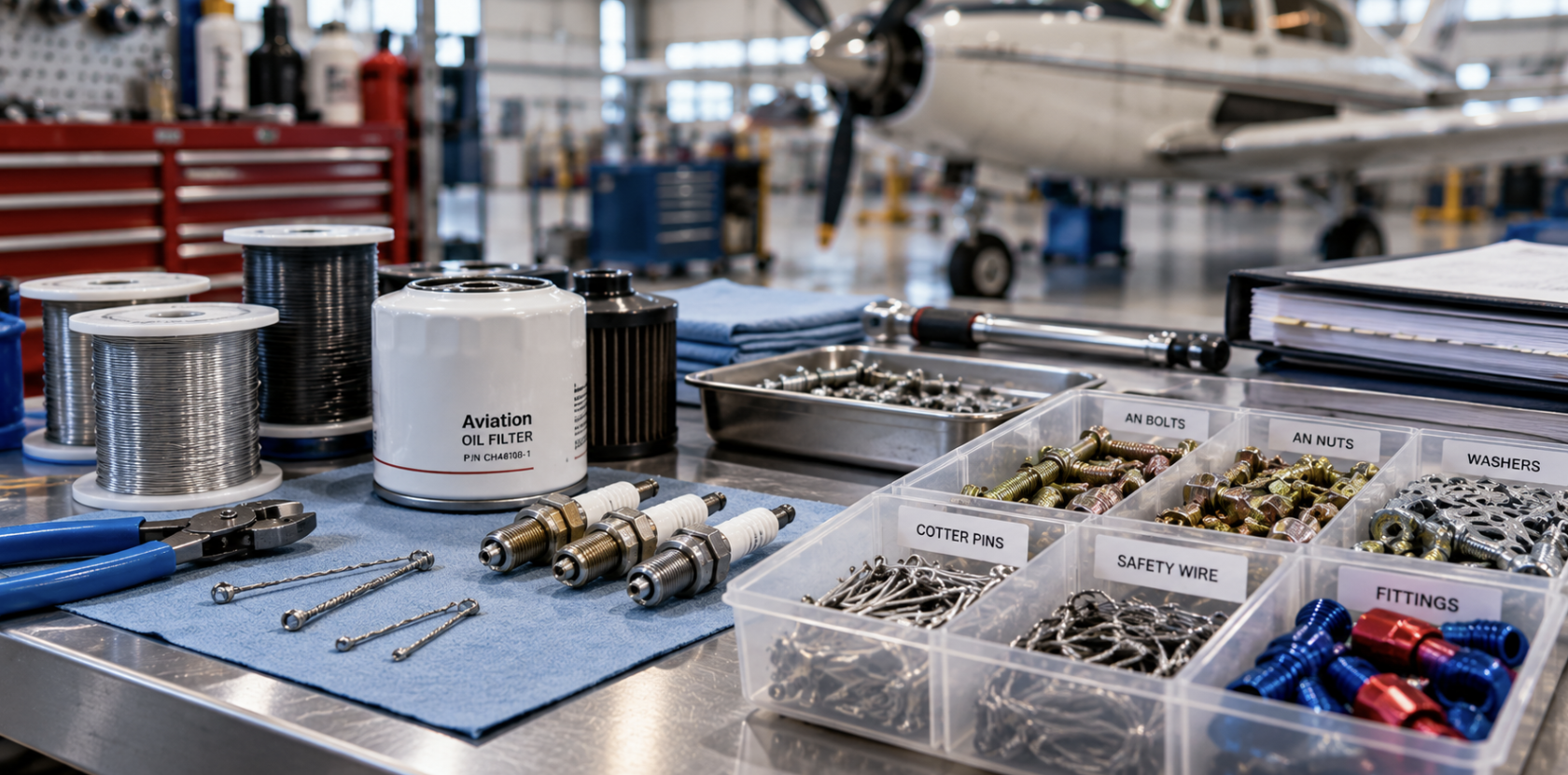
SkyGeek stocks aircraft hardware and fasteners, aviation tools and equipment, hydraulic fluid, oil, and the consumables your inspection bay runs through every season. In stock and available to ship across the US and the Americas. With more than 50 years supplying MRO shops and repair stations, we carry what a maintenance bay needs.
Documentation: Get It Before the Aircraft Arrives
The IA cannot return an aircraft to service without the records. That is not a procedural formality; it is regulatory. Under FAR 91.403, the aircraft owner is responsible for maintaining airworthiness records, and the inspector must have access to them. Missing logbook entries, undocumented AD compliance, or absent weight-and-balance data can halt an inspection that is otherwise on schedule.
Build a pre-inspection intake form and require the following before any aircraft comes in for its annual:
- Airframe, engine, and propeller logbooks
- AD compliance list covering the airframe, engine, propeller, and accessories, including magnetos, wheels, and avionics
- Current weight and balance data
- Equipment list and any Form 337 alterations
- Flight manual and applicable supplements
The FAA provides free AD lookups through its online AD database. A current, verified compliance list saves the IA significant research time and typically shortens the overall inspection. The aircraft that arrives with organized records leaves faster. For any aircraft returning with missing logbook entries or undocumented AD compliance: document what is known, note the gap in writing, and address it with the owner before inspection begins.
Scheduling Strategy for Busy Shops
Two scheduling practices make a measurable difference across a full inspection season. First, the calendar-month expiry rule works in your favor. Inspections signed in the first days of a month give the aircraft almost a full extra month of coverage compared to one signed at month-end. Same labor, more runway for the customer. Many shops pass this tip along to repeat customers.
Second, Q4 and early Q1 are peak demand periods. Operators who keep their annuals expiring in winter months fill December through February quickly. Order consumables in October and November, before the backlog builds. For high-turnover items like safety wire, oil filters, and O-ring kits, a standing replenishment order is more reliable than reacting to what is running low.
For aircraft already out of annual: the aircraft cannot be flown. A Special Flight Permit (ferry permit) from the local FSDO is required to move it to a maintenance facility. Have that conversation with the customer early. The FAA's Advisory Circular AC 20-106 provides practical guidance on aircraft inspection practices for GA aircraft owners, and is worth sharing with customers who are not familiar with what arriving organized means for shop turnaround.

Return to Service: The Last Step Before Sign-Off
Under FAR 43.15(c), before any reciprocating-engine aircraft is returned to service after an annual or 100-hour inspection, the mechanic must run the engine to verify satisfactory performance per the manufacturer's recommendations. This covers oil pressure, RPM, magneto drop, and carb heat or fuel injection operation: all checked, all within limits, all recorded. For turbine aircraft, the same requirement applies under FAR 43.15(c)(3).
After the run-up, conduct a post-maintenance functional check. Verify every system that was accessed or disturbed during the inspection: fuel lines reconnected, oil access panels secure, flight controls free and correct throughout their full range of travel. Check for fresh oil or fluid leaks before the aircraft leaves the hangar. Post-maintenance squawks are common after an annual: loose inspection panels, oil leaks from disturbed fittings, avionics issues following a battery pull. Catching them on the ground is faster and less costly than catching them at the next shop visit.
The maintenance logbook entry, the IA's signature, and the return-to-service statement must all be current and complete before the aircraft flies. Before the customer takes delivery, remind them: verify the completed maintenance against the AMM or SRM, and conduct a thorough preflight. The first flight after an annual is not the flight to rush.
How SkyGeek Supports MRO Inspection Season
SkyGeek keeps MRO shops and repair stations across the Americas stocked with the consumables and hardware they need to run inspection season without supply-chain interruptions. As part of the GracoRoberts family of aerospace materials brands, with more than 50 years in aviation supply, SkyGeek carries the full catalog your inspection bay depends on.
In-stock availability and fast fulfillment across the catalog: MIL-SPEC safety wire, aircraft hardware and fasteners, aerospace sealants, aviation oil and lubricants, hydraulic fluid, and the tools and equipment your technicians use every day. All available to order online and shipped fast across the US and the Americas.
One order for the whole job. Add safety wire, AN hardware, oil filters, sealants, O-ring kits, and ELT batteries to the same cart. SkyGeek carries the consumable and the supplies that go with it, so your team does not have to source from multiple vendors to stock one inspection bay.
Shop online at SkyGeek.com or contact our team to discuss volume orders and standing replenishment schedules before peak inspection season starts.
Frequently Asked Questions
What is the difference between an annual inspection and a 100-hour inspection?
An annual inspection is required every 12 calendar months for most civil aircraft under Part 91 and must be approved by an IA, a Part 145 repair station rated for the aircraft type, or the aircraft manufacturer. A 100-hour inspection applies to aircraft operated for hire or used to provide flight instruction for hire, and an A&P without an IA can approve it. An annual satisfies any outstanding 100-hour requirement. A 100-hour does not substitute for an annual.
How long is an annual inspection valid?
An annual inspection is valid for 12 calendar months after it is signed. It expires at the end of the 12th calendar month, not 12 months from the inspection date. An inspection signed March 15 expires at midnight on March 31 the following year, which means the aircraft can fly through the last day of March without needing a new annual.
Who can approve an annual inspection and return an aircraft to service?
Only an IA (Inspection Authorization holder), a Part 145 repair station appropriately rated for the aircraft type, or the aircraft manufacturer. An A&P mechanic without an IA can perform maintenance and assist with the physical inspection but cannot sign off the annual or issue the return-to-service approval.
What happens if an aircraft's annual inspection expires?
The aircraft may not be operated under FAR 91.409. To fly it to a maintenance facility, the owner or operator must obtain a Special Flight Permit (ferry permit) from the local FSDO. The aircraft is grounded until the annual is completed and signed by an authorized IA or Part 145 repair station.
What consumables are typically needed for a GA aircraft annual inspection?
Common consumables include engine oil, oil filters, spark plugs, air induction filters, AN900-series aluminum crush gaskets, MIL-SPEC safety wire (MS20995 series in both 0.032 inch and 0.041 inch), cotter pins, wheel bearing grease, hydraulic fluid, ELT battery, cad-plated access panel screws, and any sealants or thread-locking compounds specified in the aircraft's maintenance manual. Specific requirements vary by aircraft type and engine model.
Follow Skygeek