
Aircraft Maintenance Consumables: What to Stock for Line vs. Base Maintenance
Oct 29th 2026

Two maintenance operations can support the same aircraft type and still require very different consumables strategies. Many products overlap, but consumption patterns, order quantities, storage requirements, and replenishment cycles can vary dramatically between line and base maintenance environments. This guide separates the two, names the specifications behind each product class, and gives you a practical way to size what you hold.
Line Maintenance vs. Base Maintenance: What Changes for Your Stockroom
Line maintenance is work performed with the aircraft in service, typically on the ramp or at the gate between flights. It covers transit, daily, and weekly checks, servicing, defect rectification, and deferred item clearance under the minimum equipment list.
Base maintenance is work that takes the aircraft out of service and into a hangar for an extended period. C-checks, heavy structural inspections, corrosion treatment, modifications, and paint fall into this category.
| Factor | Line Maintenance | Base Maintenance |
|---|---|---|
| Work location | Ramp, gate, remote station | Hangar, controlled environment |
| Typical duration | Minutes to a shift | Days to weeks |
| Dominant tasks | Servicing, inspection, defect rectification | Structural inspection, repair, corrosion treatment, refinishing |
| Package size | Small: aerosols, tubes, cartridges, quarts | Large: gallons, kits, bulk rolls |
| Dominant consumables | Lubricants, cleaners, safety wire, servicing fluids | Sealants, primers, adhesives, abrasives, topcoats |
| Shelf life exposure | Low. High-turn items | High. Two-part chemistry with dated life |
| Stocking model | Continuous min/max replenishment | Check-driven kitting against a work package |
Line Maintenance Consumables: What Belongs on the Truck
Line stock is about speed and portability. Technicians need the right item within arm's reach, in a package one person can carry, with no mixing or cure window standing between the defect and the release.
Lubricants, greases, and oils
Lubrication is the highest-frequency consumable draw on the line. Hold general purpose low-temperature lubricating oil to MIL-PRF-7870 for hinges, latches, and control linkages, and wheel bearing grease to MIL-PRF-81322 for landing gear servicing. Both sit in the broader aviation lubricants range alongside the greases and specialty oils called out on individual task cards.
Turbine engine oil to MIL-PRF-23699 or MIL-PRF-7808 belongs in line stock for any operation performing engine oil servicing, in the OEM-approved brand for your powerplant. Where liquid lubricants attract contamination, an air-dry solid film lubricant to MIL-L-23398 is the practical alternative.
Penetrating oil belongs on every line truck. Corroded and seized fasteners are one of the most common reasons a routine panel removal turns into a delay, and a can of penetrating lubricant in the toolbox is cheaper than the drill-out that follows.
Safety wire, tapes, and hardware
Safety wire is consumed constantly and almost never planned for properly. MS20995C32 in 0.032 inch corrosion-resistant steel covers the majority of general airframe and engine applications, with lighter and heavier gauges held for specific tasks. Pair it with quality safety wire pliers, since worn twisters are a recurring cause of wire breakage and rework.
Keep both grades of anti-seize in line stock. MIL-PRF-83483 molybdenum disulfide-petrolatum thread compound covers general fasteners and fittings, but the specification cautions against using it above roughly 1000 degrees F, where the moly can induce hot corrosion. MIL-PRF-907 is the high-temperature compound, rated to 1050 degrees F for exhaust and hot section work. Self-fusing silicone tape to A-A-59163 and aerospace-grade tapes round out the fast-fix inventory.
Cleaners, solvents, and wipes
Cleaning products carry more compliance risk than most stores realize, because the wrong solvent on the wrong substrate creates a finding rather than a fix. Stock dry cleaning solvent to MIL-PRF-680, isopropyl alcohol for general surface preparation, and low-residue electrical contact cleaner for connector work.
Add exterior degreaser, lint-free wipes, and acid brushes. The broader aviation chemicals catalog covers the specialty items that appear on specific task cards.
Servicing fluids
Line servicing runs on fluids. Hydraulic fluid is the critical one, and the specification is not interchangeable. Phosphate ester fluids to BMS3-11 serve most transport category aircraft, while MIL-PRF-5606 and MIL-PRF-83282 mineral-base fluids serve other platforms. Mixing them destroys seals.
Hold landing gear strut fluid, nitrogen servicing hardware, and tire pressure gauges alongside it. Verify against the maintenance manual before any top-off.
Seasonal and station-specific items
Cold-weather stations need deicing and anti-icing fluid to SAE AMS 1424 for Type I and AMS 1428 for Types II, III, and IV, plus deice boot care products where applicable. Operations performing on-wing engine cleaning should hold turbine engine compressor wash in the OEM-approved formulation. Order these on a seasonal forecast, not a rolling average, or you will run short in the first cold snap.
Base Maintenance Consumables: What a Heavy Check Consumes
Base stock is about volume, cure control, and traceability. Most of what a heavy check consumes is dated chemistry that has to be stored correctly, mixed correctly, and applied within a working life measured in minutes.
Sealants
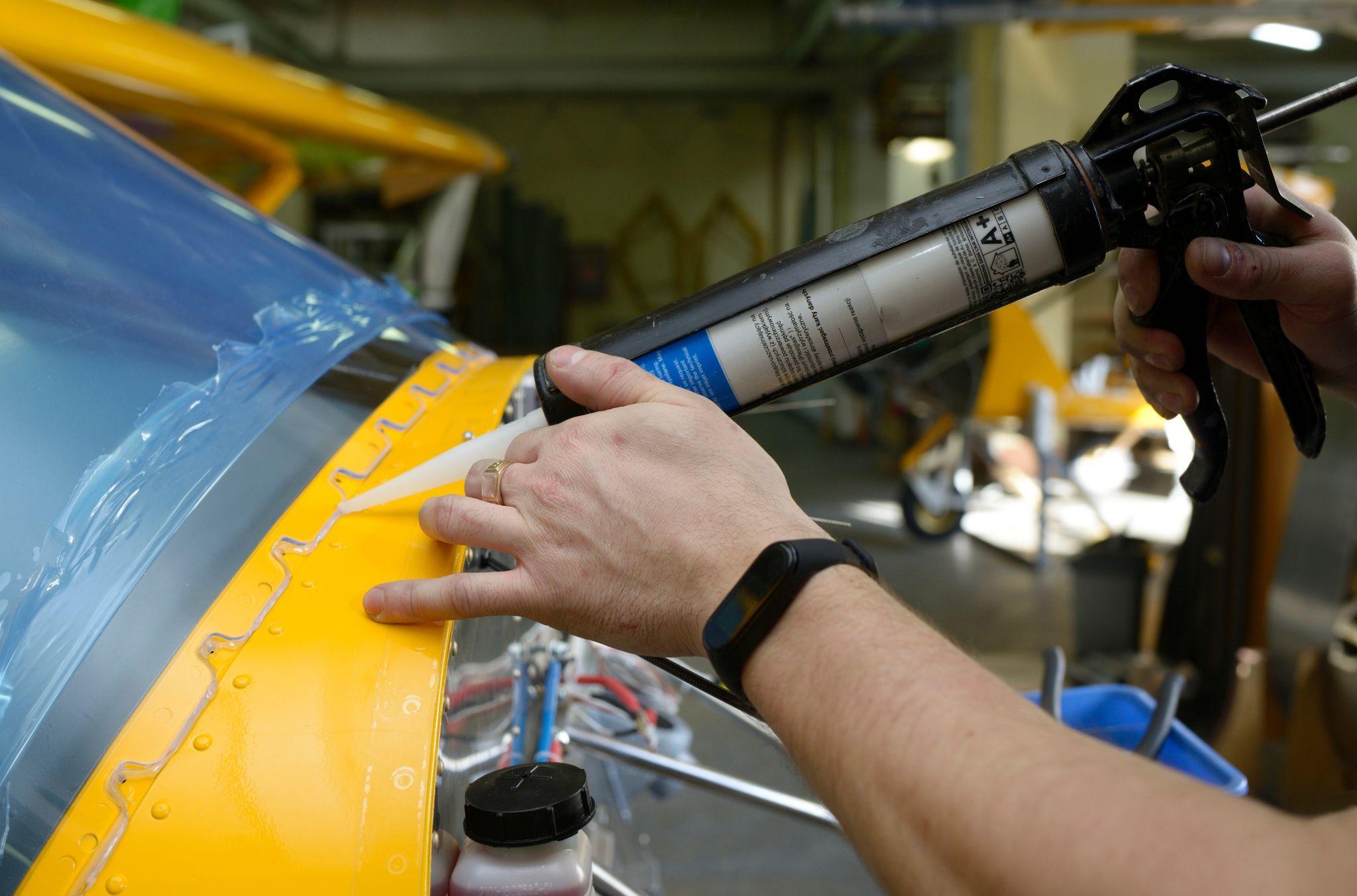
Sealant is the single largest consumable category in a heavy check. Aerospace sealants divide into corrosion-inhibiting sealants to MIL-PRF-81733, such as PS-870 B-1/2, and integral fuel tank sealants to AMS-S-8802, such as PR-1440 B-1/2.
Class designations matter for ordering. Class A brushable, Class B fillet-grade, and Class C faying surface sealants are not substitutes for one another. The suffix is the working clock: a B-1/2 gives roughly a half hour of application life after mixing, while a B-2 gives about two hours. Order the suffix that matches the job, not the one that happens to be in stock. Our guide to aircraft sealants breaks down the class and cure-time system in detail.
Structural adhesives
Structural repair drives demand for two-part epoxy adhesives. Room-temperature-curing paste adhesives are common for composite and metal bonded repairs, and film adhesives appear on specific repair schemes. Confirm the exact product called out in the structural repair manual, because substitution is not a maintenance decision.
Corrosion control, primers, and topcoats
Corrosion findings drive a predictable consumable chain, and the treatment sequence in FAA AC 43-4B is the baseline where the manufacturer has not published its own corrosion control program. Treatment begins with surface preparation and conversion coating, including chromate and chromate-free metal prep products and conversion coating touch-up kits.
From there, epoxy primers to MIL-PRF-23377 or the chrome-free equivalents provide the corrosion barrier, followed by polyurethane topcoats to MIL-PRF-85285. Hold water-displacing corrosion preventive compounds to MIL-PRF-16173 Grade 3 for cavity and lap joint treatment. Older stock and some product labels still show MIL-C-16173, which the current performance specification superseded in 1993, so check the revision when reconciling stores records.
Abrasives and surface preparation
Base maintenance consumes abrasives at a rate line stations never approach. Non-woven surface conditioning discs, sanding discs, flap wheels, and deburring products all appear in paint removal, blend-out, and composite repair. Grade selection matters, since aggressive media on thin skin removes more material than the allowable damage limits permit.
Inspection consumables
Heavy checks are inspection events first and repair events second. Hold liquid penetrant inspection materials to AMS 2644, currently at Revision J. Penetrant, remover, and developer are qualified as a system rather than individually, so mixing brands across the three breaks the qualification. Keep non-corrosive marking materials on hand as well, since standard markers can introduce sulfur or chlorides onto the structure.
Shelf Life Is the Real Cost Driver
The most expensive consumable mistake is not underbuying. It is buying a case of two-part sealant against a check that slips six weeks and watching the whole quantity expire in storage.
Treat these as planning ranges only. The certificate of conformance and the manufacturer technical data sheet govern, and shelf life runs from date of manufacture rather than date of receipt.
| Product class | Typical planning range | Storage consideration |
|---|---|---|
| Two-part polysulfide sealants | 9 months or more from date of manufacture | Manufacturer data for PR-1440 Class B states at least 9 months stored below 80 degrees F in unopened containers. Premixed frozen cartridges require freezer control and a documented thaw process |
| Two-part epoxy adhesives | Roughly 12 months | Ambient controlled storage. Verify per product |
| Epoxy primers and topcoats | Roughly 12 to 24 months | Temperature-controlled storage. Activator and base often differ |
| Penetrant inspection materials | Roughly 12 months | Protect from light and heat. Keep the system matched by batch |
| Lubricating oils and greases | Multi-year in most cases | Sealed original containers. Avoid contamination on decanting |
| Solvents and cleaners | Multi-year in most cases | Flammable storage requirements apply |
Two habits keep this under control. Store dated chemistry in a first-expired, first-out arrangement rather than first-in, first-out. Then, for anything with a life under 12 months, buy against a confirmed work package instead of a rolling minimum.
How to Size Reorder Points for Each Environment
Line and base need different inventory logic. Applying one model to both is what creates simultaneous stockouts and write-offs.
- Set line minimums from usage, not intuition. Pull 12 months of issue history, calculate weekly consumption, and set the reorder point at lead time consumption plus a buffer sized to your station's resupply reliability.
- Kit base consumables against the work package. Build the sealant, primer, adhesive, and abrasive requirement from the planned task cards and expected findings, then order to that number.
- Carry a findings allowance. Corrosion and structural findings are discovered, not planned. A 15 to 25% allowance on corrosion treatment materials is more realistic than ordering to the planned scope alone.
- Separate AOG stock from routine stock. AOG items should be held physically apart and excluded from routine consumption, or they will be quietly drawn down before you need them.
- Track expiry as an inventory metric. Value of material written off to expiry per quarter tells you more about stocking accuracy than fill rate does.
Building Your Stocking List
If you are starting from scratch or rebuilding a station list, work through it in this order.
- Pull the applicable specifications from your maintenance manual, structural repair manual, and consumable materials list. Specification first, brand second.
- Separate items by maintenance environment, using the line and base split above.
- Flag every dated item and note its typical shelf life against your expected check interval.
- Set replenishment for high-turn line consumables and package-driven ordering for base chemistry.
- Consolidate suppliers where it reduces qualification and documentation overhead without limiting product access.
Sourcing Consumables Without the Procurement Friction
SkyGeek has supplied the aviation industry for more than 40 years and operates as an AS9120B certified aerospace distributor. That certification covers the quality management requirements specific to distribution, including traceability, documentation, and product control.
Practically, that means specification data on the product page, documentation available on request, and no membership fees or minimum order quantities standing between your operation and a single quart of sealant. Special order capability through the GracoRoberts network covers items outside the standard catalog.
Ready to build or refresh your list? Browse the full range of aviation hangar supplies and consumables, or contact the SkyGeek team to set up account terms and volume pricing for recurring consumable supply.
Aircraft Maintenance Consumables FAQ
What is the difference between line maintenance and base maintenance?
Line maintenance is performed with the aircraft in service, usually on the ramp between flights, and covers transit and daily checks, servicing, and defect rectification. Base maintenance takes the aircraft out of service into a hangar for extended work such as C-checks, structural inspection, corrosion treatment, and modifications. EASA Part-145 organizations hold separate line and base ratings.
What are consumables in aviation maintenance?
Consumables are materials used up during maintenance that cannot be reused or returned to stock, including sealants, adhesives, lubricants, solvents, primers, abrasives, safety wire, and cleaning supplies. They are tracked separately from rotable and repairable parts because they are controlled by specification and shelf life rather than by serial number.
Which consumables should a line maintenance station always stock?
General purpose lubricating oil to MIL-PRF-7870, wheel bearing grease to MIL-PRF-81322, turbine engine oil in the OEM-approved specification, safety wire such as MS20995C32, anti-seize compound, dry cleaning solvent to MIL-PRF-680, isopropyl alcohol, lint-free wipes, the correct hydraulic fluid for the fleet, and aerospace tapes.
How long do aircraft sealants and adhesives last in storage?
Two-part polysulfide sealants commonly carry a planning range of roughly six to nine months from date of manufacture, and two-part epoxy adhesives often around 12 months. Always verify the actual shelf life on the certificate of conformance and technical data sheet, since it varies by product, class, and storage condition.
Do consumables need to meet MIL-SPEC or AMS requirements?
Yes, when the maintenance data calls out a specification. The maintenance manual, structural repair manual, or task card specifies the required standard, and the product supplied must conform to it. Specification data should be listed on the product page and supporting documentation available on request.
How do I avoid writing off expired consumables?
Store dated chemistry on a first-expired, first-out basis rather than first-in, first-out, buy anything with a shelf life under 12 months against a confirmed work package instead of a rolling minimum, and track write-off value per quarter as an inventory accuracy metric.
Follow Skygeek